For session A of Fall 2024, I took a class called Creative Thinking and Design Visualization. For our final project, we worked in groups to reinvent an existing physical product. My teammates and I chose to reinvent the classic TV remote.
The Product: Re-Mote – “Never Lose your Re-Mote again!”
Project team: Vivian Salas, Zachary Goodpaster, Jerah Andre, Joe Schmoe
The standard TV remote, even across varying brands and designs, is pretty universal design-wise. You have the power button and guide/menu buttons on the very top; the number keys; the directional keys; the red, green, yellow, and blue buttons; the volume controls; and so on. The order of the buttons may vary slightly depending on the brand and the specific remote model, but the design and order of the components is relatively universal.
One of the main problems with TV remotes is that they can be easily lost; They’re small and can fall in between the couch cushions without being noticeable, which in turn makes them hard to locate. The experience is also not customizable; The buttons on the remote are permanent and can’t be relocated or reorganized. There is also frustration with the batteries; Not a lot of products use one-time use AA/AAA batteries anymore as we’ve moved onto lithium-ion batteries; Rechargeable AA/AAA batteries do exist, but most gadgets and technology that rely on battery power tend to use rechargeable lithium-ion batteries instead.
This new product is called a Re-Mote, as we are redesigning the standard Remote. There are a few common issues like the ones above that people experience while using TV remotes that inspired us to reinvent the remote to provide a more smooth and enjoyable experience.
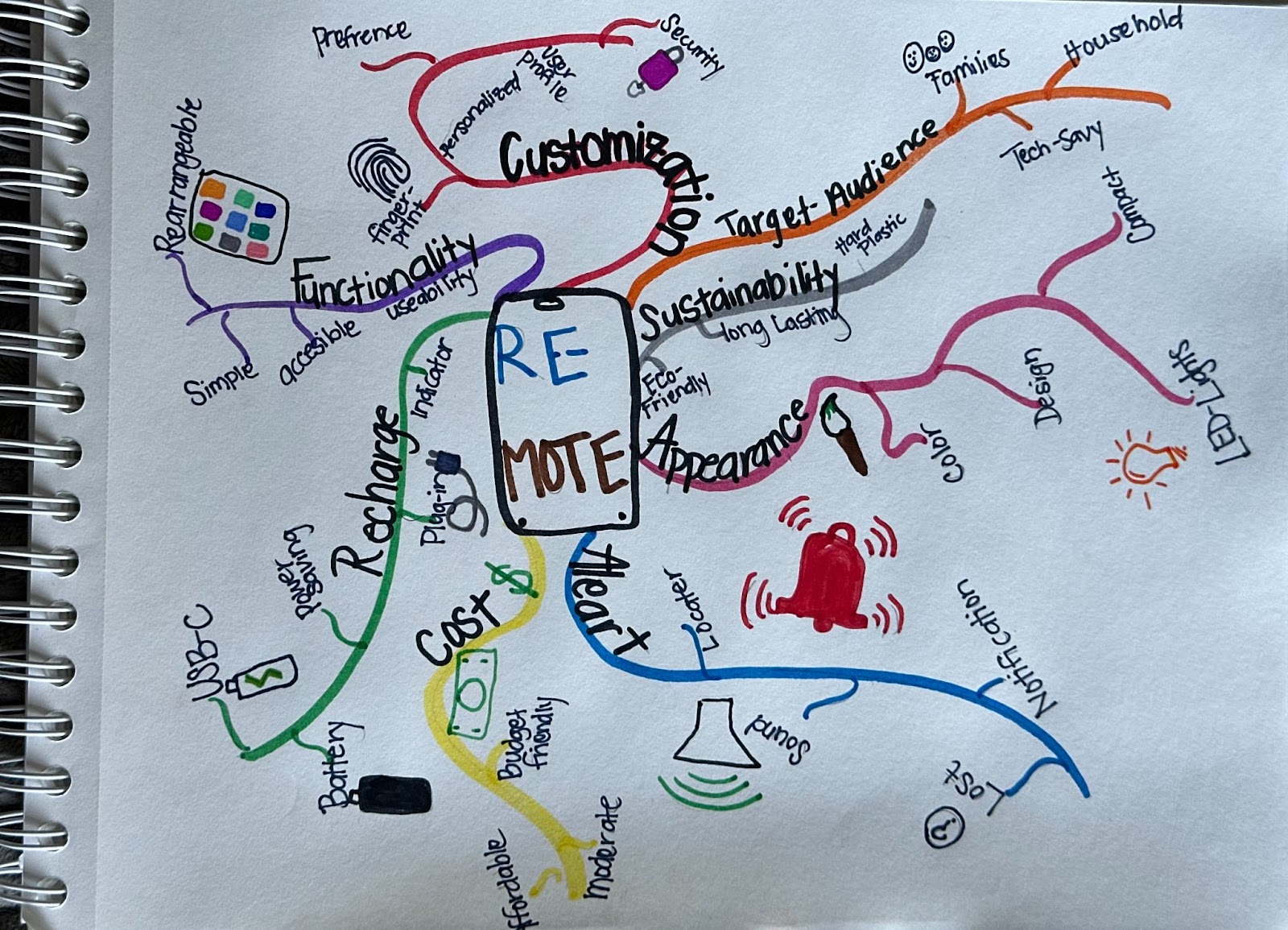
Mind map by Jerah Andre.
As mentioned above, many people get frustrated when they cannot find their TV remote, oftentimes losing it and being unable to locate it since it’s small and can easily be missed or hidden in less visible places. We wanted to give the standard TV remote a redesign to include features that not only allow users to locate their remote via voice control, and phone applications, for example. We also wanted to add some features that allow for customization, such as biometrics for user profiles, allowing users to rearrange buttons at any time, and adding rechargeable batteries to help eliminate the frustration of running out of one-time use batteries.
The target audience for the Re-Mote is individuals who frequently watch and use their TV, whether it’s with streaming services, cable TV, or other purposes. As mentioned above, the frustrations with easily losing the remote as well as frustrations with batteries put a damper on the user’s experience. By allowing for more customization, ways to locate the remote should it get lost, as well as switching from one-time use batteries to rechargeable lithium batteries, this provides a more accessible and enjoyable experience for the user.
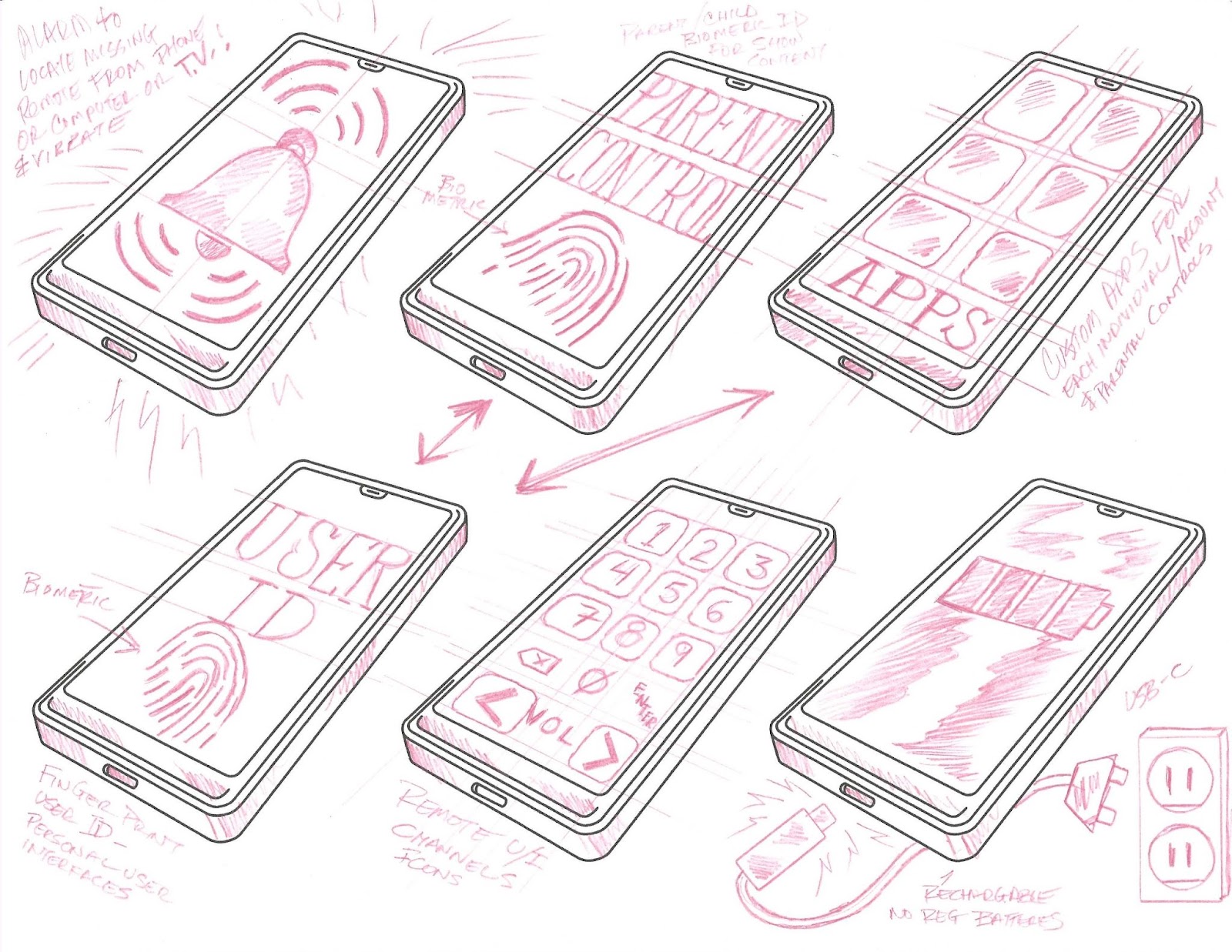
Ideation sketches by Joe Schmoe for the product: Re-Mote.
The Re-Mote has never-before seen features that allow for customization that was not previously available – or even thought of – in a TV remote. It is also more accessible than the average TV remote, allowing connectivity to any TV and smartphone, as well as having auditory location pinging features to aid in finding the Re-Mote if it’s lost. There’s also features that allow users to use their smartphone as the Re-Mote in the meantime until the Re-Mote is able to be located.
The Re-Mote is constructed in a similar way to smartphones; It is more durable compared to the plastic used in most remotes and has a touch screen instead of buttons. The Re-Mote has ways of locating it via voice, audio signals, and applications; allows for biometric identification for custom user profiles as well as online purchases; has rechargeable batteries like a smartphone so you can do away with one-time batteries; customizable buttons and channels for individual user profiles; and connectivity to smartphones as another avenue of relocation should the Re-Mote get lost, as well as allowing for the smartphone itself to be used as the Re-Mote in the meantime.
The cost would be similar to other existing smart remotes on the market, which currently go for around $80-120. The Re-Mote would be around $120-150, as it has more plentiful and customizable features compared to other smart remotes. As mentioned above, the Re-Mote can be used with any TV for anything, be it streaming services, cable TV, online purchases through applications, and so forth – as well as connecting to smartphones.
Logo design by Joe Schmoe.
 Zachary Goodpaster
Leave a comment